
This is not corruption, strictly speaking. Corruption implies a norm being violated. What we have in Lebanon is the norm.
Here is what the generator actually encodes, if you look at it long enough. The state failed to provide a service. A private operator stepped in to fill the gap. The private operator captured the gap politically: made the gap his business model, his revenue stream, his entire reason for existing. Any reform that fixed the electricity grid would destroy him. So he prevents the reform. The state stays broken. The generator stays running. And you, standing in your kitchen at 2am waiting for the amperes to kick back in, have just experienced the Lebanese social contract in its most honest form.
Now scale that logic to everything.
The generator is electricity. But it is also the private school your child attends, because the public school has not had functioning textbooks since 1997. It is the private hospital where you bribed the nurse for a bed, because the public hospital ran out of medicine in 2020 and has not run back in. It is the water tank on your roof, because Beirut's water network loses forty-eight percent of what it carries to leakage that nobody is paid to fix. It is the wasta call you made to your cousin's contact at the ministry to process a permit that should have taken three days and took eight months without the call. Every essential service that should, in a country that functioned, produce a shared civic identity, the feeling that we are all in this together, that the lights come on for everyone, has been privately captured, fragmented, and handed to someone who profits from the fragmentation continuing.
The result is not a broken state. It is a state that has been deliberately hollowed into a theatre set. The facade exists. The ministries exist. The official seals and the letterheads and the men in suits who sign documents: all present. But behind the facade, the actual governance of daily life has been distributed outward, downward, and privatized, until the only unit that reliably functions is the one small enough for one family to control.
Which brings me to the thing nobody has named properly, though everyone who has lived in Lebanon has felt it: the pattern does not stop at the generator. It replicates.
At the national level, the state fractures into eighteen sects, each running its own hospitals, schools, courts, and political militia. At the sectarian level, each sect fractures into competing za'im networks, each controlling a neighborhood or a district or a port entrance. At the neighborhood level, each area becomes a micro-sovereignty. Achrafieh has its own informal governance, Dahieh has its own, Tariq el-Jdideh has its own, and during the 2024 war the mayor of Rmeil explained, with a straight face, that his neighborhood had no shelter space for the displaced, which everyone understood to mean the displaced were Shia and Rmeil is not. At the household level, each apartment building has its own generator, its own water tank, its own syndicate. And at the individual level, the Lebanese person himself has become a sovereign micro-state of one: running his own wasta network, maintaining his own informal law, playing every outside actor with the same practiced fluency he brings to playing his neighbor.
Lebanon has approximately 1,100 municipalities. It occupies 10,452 square kilometres. Connecticut, for comparison, has 169 municipalities on 14,000 square kilometres. Lebanon is not trying to deliver services efficiently. It is trying to make sure every dotted line on the map runs between a "them" and an "us," because "them" and "us" is the only political technology the system knows how to run.
This is what I mean by fractal. The pattern is not a national problem that expresses itself locally. It is a pattern that reproduces at every scale simultaneously, each scale reinforcing the others, each scale making the same structural choice: provide your own services, play every outsider, owe nothing upward, extract everything available. The National Pact encoded it at the constitutional level. The civil war activated it at the street level. The Maronite side alone fractured into the Kataeb, the Lebanese Forces, the Marada, the Guardians of the Cedars, each with its own militia and its own checkpoints and its own economy and its own theory of why the others were traitors. The post-war order reconsolidated power at the sectarian level, because the sect was the only institution that had fed you while everything else was burning, and you remember who fed you. And then the 2019 collapse pushed the atomization one level deeper still, until the individual Lebanese, sitting in the dark with his generator bill, became the final resting place of all the sovereignty that had been unable to hold anywhere above him.
I want to be precise about the person this system produces, because he is not a monster and he is not a failure. He is, in fact, extraordinary. The Lebanese individual who emerges from three generations of fractal sovereignty is a tactical polyglot who can shift register, accent, and emotional register mid-sentence depending on who he is talking to. He maintains a network of bilateral relationships so dense and so carefully tended that in any city on earth, Sao Paulo, Abidjan, Sydney, Detroit, he will find, within forty-eight hours, a Lebanese who knows a Lebanese who can help him with whatever he needs. He is capable of a generosity so extravagant it will embarrass you, and he extends it without hesitation to anyone inside his circle, because generosity is reputation currency in a zero-trust society, and he has understood this since childhood. He is, in the diaspora, a banker, a surgeon, a poet, a prime minister of other countries, a person who builds things that last.
And he double-parks his Mercedes on the sidewalk without a flicker of guilt, because public space is, to him, simply unclaimed private space. He will work the system, play you, play the foreigner, play the Israeli and the Syrian and the American and the Saudi with equal fluency, because he has learned, from his father who learned from his father, that every external actor is temporary and every alliance is transactional and the only constant is his own wits. There is a word for this in Arabic: mehtail. It is not quite "scammer." It is closer to "player," the man who sees the angle and takes it, not from malice but from a deep, bone-level understanding that nobody else is watching out for him and he had better watch out for himself.
This is not a moral failing. It is the produced subject of a fractal sovereignty machine: a person optimized, with impressive precision, for a world without commons.
The tragedy, and it is a real one, is that six million individuals optimized for a world without commons produce, in aggregate, a world without commons. Every Lebanese routing around the state makes perfect sense. Six million Lebanese routing around the state produces a state that cannot be reformed, a country that cannot arrive at a negotiating table as a single actor, a banking system that vaporizes everyone's savings with the bureaucratic efficiency of an entity that knows it will never be prosecuted, and a port that sits loaded with ammonium nitrate for six years because no single institution has both the authority and the incentive to remove it.
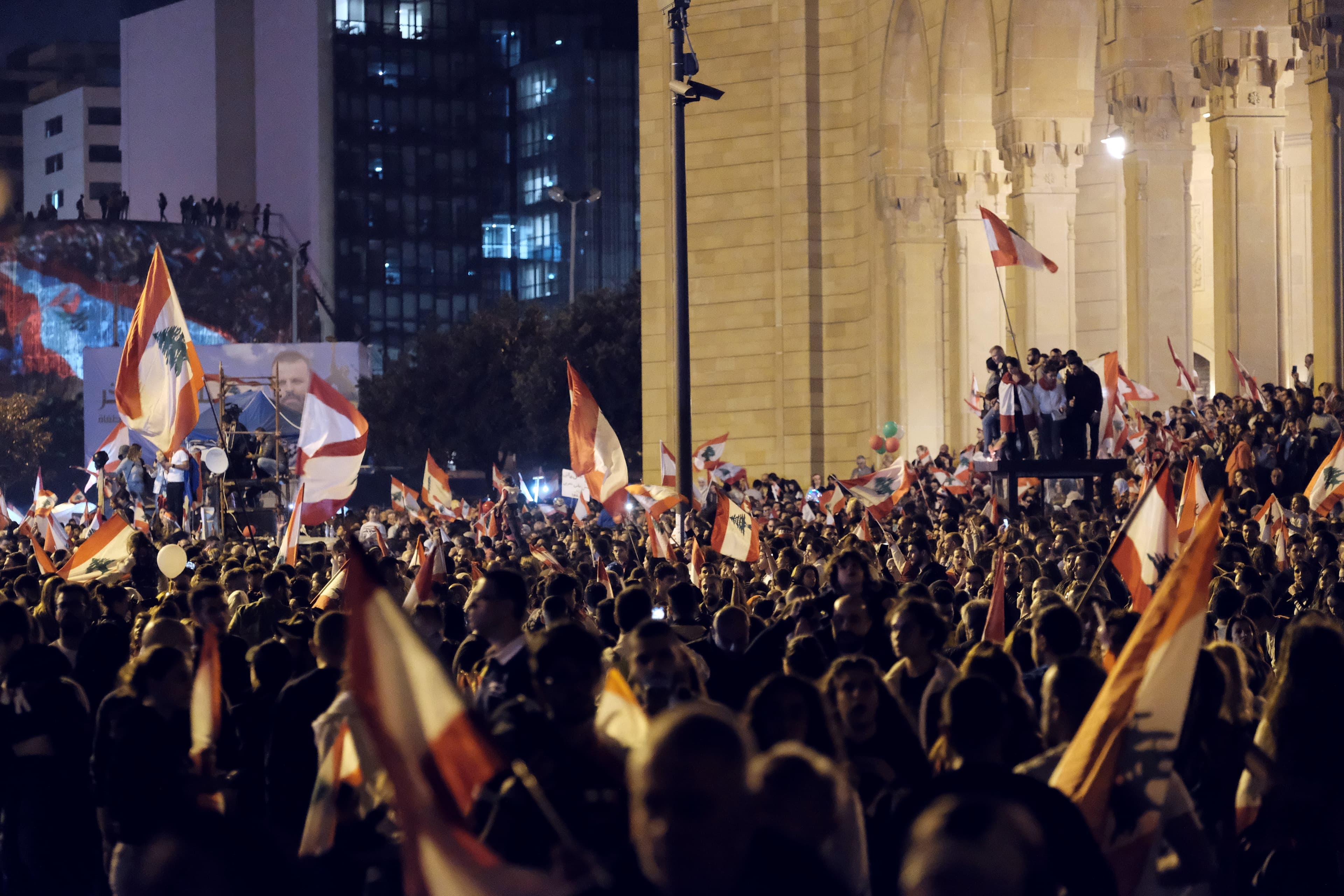
The fractal protects each unit and destroys the whole. The individual is rational. The collective outcome is catastrophic. And the machine, understanding this, has arranged things so that the moment any reform coalition threatens to actually consolidate, every franchise holder, regardless of sect, regardless of political position, regardless of what they were screaming at each other about last week, converges to crush it. In October 2019, the Lebanese took to the streets in the only genuinely cross-sectarian mass movement the country has produced since independence. Hezbollah and the Lebanese Forces agreed on nothing except that it had to end. It ended. The machine exhaled and went back to running.
The generator is still in the basement.
It is humming right now, actually. Constant, indifferent, profitable. It does not care who is president. It does not care which militia controls which port entrance. It does not care whether the ceasefire holds or whether the reform package passes or whether the international community sends another delegation to express concern. It runs on diesel and on the structural impossibility of the alternative, and in that sense it is the most honest institution in the country.
Lebanon will have solved its political problem the day the generator goes quiet.
I would not hold your breath.